Cutting straight to it: concrete pumps are available in various sizes for one basic reason: various projects require various demands.
Turn up to a commercial high-rise job with a small trailer pump and you might as well pack your bags for Christmas. Turn up to a small residential driveway job with a massive 62m boom pump and you might be there longer trying to get it into position than it would take to pump it. And besides, you're paying for capacity that's not needed.
The goal here is simple: match the machine to the work. Not too big, not too small. Just right.
But to do that, you have to understand a few basics about how these machines work and what limits them.

Before you can size anything, you need to know what your options are. Concrete pumps generally fall into three categories, and each one has its place.
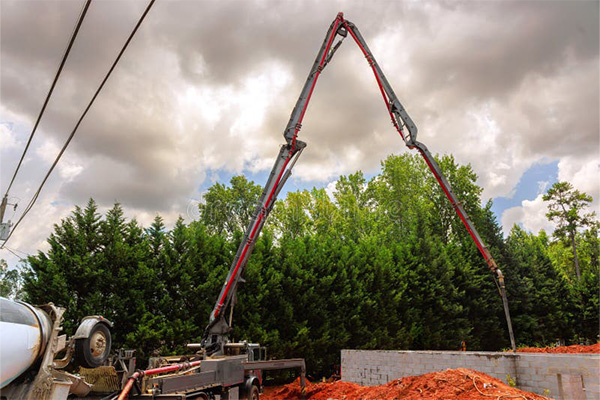
These are the big boys with the robotic arms you see on larger commercial sites. That hydraulic boom lets operators place concrete with serious precision, even at height or over obstacles. If you're working on a multi-story building, a bridge, or any job where concrete needs to go up and over things, this is your tool. They're mounted on trucks, so they're mobile, but they need space to set up and extend that boom.
Think of these as the middle ground. You get the mobility of a truck with the flexibility of pumping through hoses. These are common on residential and commercial jobs where you need to move concrete around obstacles but don't necessarily need the vertical reach of a full boom pump. They're versatile and can handle a lot of different situations.
Small, tough, and easy to move around. Trailer pumps are the workhorses of smaller jobs—house foundations, slabs, pool decks, stuff like that. They sit on a trailer, you tow them to the site, and they pump concrete through hoses to where you need it. They're great for tight spaces where a truck-mounted rig can't go.
The first thinThe first thing to ask yourself is: what are we building here?
Well, volume is important. You're talking about 10 yards of concrete. Any pump can handle that. You're talking about 200 yards of concrete. You're going to want a pump that can handle it and not break down on you. More volume means a bigger pump with a higher output.
Distance is also important. How close is the pump going to be to where the concrete is going? You're talking about 200 feet. That's one thing. You're talking about 200 feet up the side of a building. That's a different story altogether. It's a lot harder on a pump going up than it is going out.
Placement is also important. Where is the concrete going? Is it going into a form at ground level? Is it going into a form on the second story? Is it going into a foundation hole? Is it going down in a tunnel? Where it needs to go is how it needs to get there.
You can have the perfect pump on paper, but if it won't fit on site, it's useless.
Space to set up. A big boom pump needs room to spread its outriggers and unfold that arm. If you're working in a tight alley or a cramped backyard, that's not happening. Trailer pumps and line pumps have a much smaller footprint and can work in tighter spots.
Overhead stuff. Power lines are the enemy of boom pumps. You need to know what's above you before you start extending that boom into the sky. If there are lines in the way, you might be forced into using a line pump with hoses instead.
Ground conditions. Soft ground, mud, steep slopes—all of that affects where you can position a heavy truck and whether it'll stay stable while pumping.
Not all concrete pumps are created equal when it comes to pumping all types of concrete mixes. This is where a lot of people get confused.
It matters what type of mix you're pumping. Concrete with large aggregate—1-inch rock or larger—is more difficult to pump than concrete with smaller aggregate. It requires larger hoses and more horsepower. If your mix has fibers or other materials, this affects things as well.
Slump test results. Slump is a measure of how wet or dry your concrete is. Concrete with low slump is stiff and difficult to push through a hose. Concrete with high slump is more fluid. Your pump must be compatible with the slump you're working with. If your mix is too stiff for your pump, you're facing a bottleneck.
Volume over time. How quickly do you need this concrete delivered? If your crew is standing around waiting, you need a pump that can deliver yards per hour at a reasonable rate. Be sure to check the pump's output and ensure it meets your schedule.
Once you've got all that down, it's time to do some basic math.
Calculate the total volume. To find the volume in cubic feet, multiply the length, width, and height. To find the volume in cubic yards, divide the cubic feet by 27. That's the amount of concrete you're working with.
Calculate the distance and height. Measure the distance from where the pump will be placed to the furthest point the concrete will be placed. That's your distance. It's the height plus the distance.
Think about the pumping rate. How many yards per hour do you need to pump? That will give you an idea of the pump you need.
Check the manufacturer's charts. Manufacturers make pump charts for a reason. They want you to know the specifications of their pump. They want you to know the distance it will pump, the output it will produce, and what it will pump. They want you to know what their pump will do.
Weight and size. Will the site hold the weight of a large truck? Some residential streets or lightly constructed access roads may not hold the weight of a fully loaded concrete pump truck. Know before you go.
Maintenance history. If you are renting the pump, ask about the pump's history. A pump that's been beaten to death won't pump like one that's been well taken care of. Also, if parts are hard to get, if you break down, you'll ruin your schedule.
Operator experience level. Some pumps are easier to operate than others. If you've got a green operator, then maybe you shouldn't give them the most complex pump in the fleet.
Safety first. These pumps operate at high pressures and move heavy material. Be sure to keep people back, watch for overhead obstructions, and never overload the pump. The safety guidelines were developed because people got hurt figuring out what not to do.
The question of choosing the correct size of concrete pump essentially boils down to a few simple questions. What is the application? How much concrete is required? How far does it have to go? What is the environment like? What is in the mix?
Answer these questions and you will be halfway there. Then it is a matter of checking out the specifications and making a decision.
The correct concrete pump will ensure that the concrete keeps flowing, the men stay busy, and the project stays on track. The incorrect concrete pump will cost you time, money, and piece of mind.
A: Boom pumps have a robotic arm that places concrete precisely, great for height and obstacles. Line pumps use hoses and are better for ground-level work or tight spaces where a boom can't fit.
A: Check aggregate size and perform a slump test. Larger aggregate requires larger lines. Low slump (stiff mix) is harder to pump than high slump (wet mix). If you are unsure, call the ready-mix supplier; they live with this every day.
A: Yes, but to a certain extent. The discharge of concrete can be vertical using a trailer pump. But it is not as efficient as a truck-mounted boom pump. You can refer to the specifications of your pump.
A: You'll fight clogs, slow placement, and possibly a breakdown from overworking the machine. The crew waits, the schedule slips, and you might end up paying for a second pump anyway. Better to go a little bigger than necessary.
A: It varies by model, but boom pumps need space for outriggers to extend and the boom to unfold without hitting anything. Tight sites often require smaller pumps or line pumps with hoses.






